When you call an ambulance, you are not calling one person. You are calling a small team: someone who takes the call, someone who drives, and one or more trained people who care for the patient on the way. Knowing who is on an ambulance team, and what each person is responsible for, helps you understand what to expect and which type of ambulance to ask for.
At Annai Ambulance we have been running ambulance services in Coimbatore since 1995. Here is how a typical ambulance team works.
Who Is on an Ambulance Team?
The exact crew depends on the type of ambulance and the patient’s condition. A basic transfer may need only a driver and an ambulance attendant, while a critical-care transfer may add a paramedic, a nurse or a doctor. The main roles are:
- Call coordinator (dispatcher)
- Ambulance driver
- Ambulance attendant
- Emergency medical technician (EMT)
- Paramedic
- Nurse or doctor (for ICU and ventilator transfers)
Call Coordinator: The First Point of Contact
The team’s work starts the moment the phone rings. The call coordinator:
- Takes the caller’s location, the patient’s condition and a contact number
- Asks the questions needed to send the right type of ambulance (basic, ICU, ventilator or mortuary)
- Dispatches the nearest suitable vehicle and keeps in touch with the crew
- Gives simple instructions to the family while they wait
A clear, calm call saves minutes. Read more about why rapid ambulance response matters.
Ambulance Driver: Safe and Fast Transport
The driver’s job is much more than driving. Responsibilities include:
- Reaching the patient quickly by the safest, fastest route
- Driving smoothly so the crew can work and the patient is not jolted
- Checking the vehicle every shift: fuel, oxygen supply, siren, lights and stretcher
- Helping lift and shift the patient when needed
Ambulance Attendant: Hands-On Patient Support
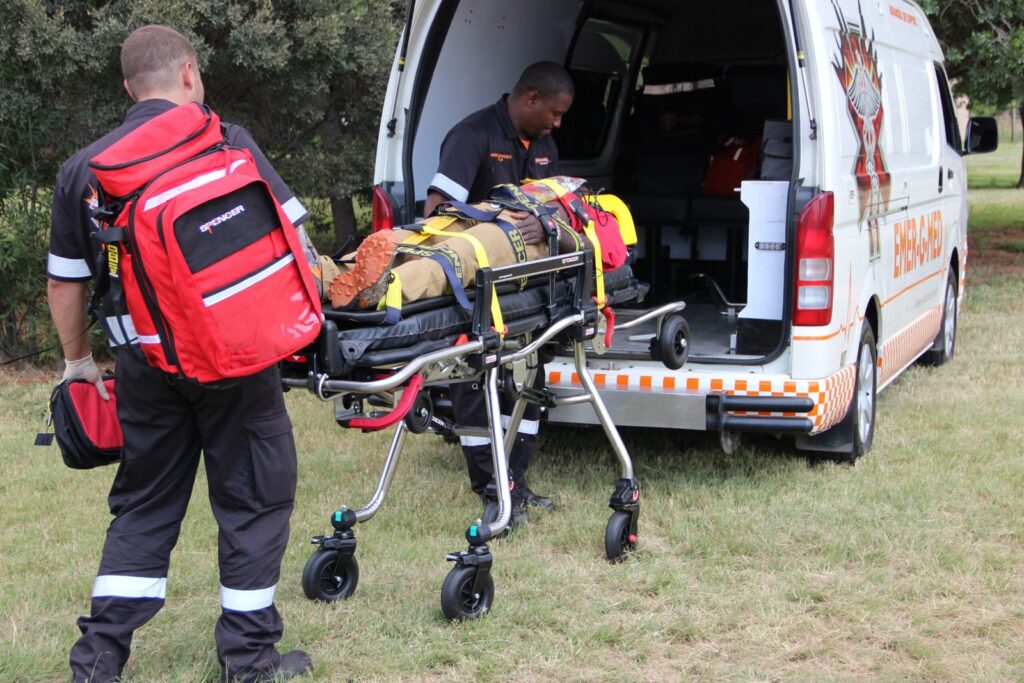
The ambulance attendant stays with the patient in the back of the vehicle. Their role and responsibilities include:
- Moving the patient safely onto the stretcher and into the ambulance
- Giving oxygen and basic first aid as instructed
- Watching the patient’s breathing, pulse and comfort throughout the journey
- Reassuring the patient and the family member travelling with them
- Handing over the patient and their details at the hospital
EMT and Paramedic: Medical Care on the Move
On advanced life support (ALS) ambulances, trained EMTs and paramedics give medical care before the patient reaches hospital. They:
- Assess the patient on arrival and check vital signs
- Use equipment such as the defibrillator, ECG monitor, suction and oxygen
- Give life-saving care such as CPR and airway support
- Keep a record of the patient’s condition and treatment for the hospital team
- Inform the receiving hospital so they are ready when the ambulance arrives
This early care can make a real difference in emergencies such as a heart attack, stroke or serious accident.
Nurse or Doctor: Critical-Care Transfers
For critically ill patients moving between hospitals, an ICU ambulance may carry a nurse or doctor with critical-care experience. Their responsibilities include:
- Continuing the treatment the patient was receiving in the hospital
- Managing infusions, monitors and, where needed, the transport ventilator
- Responding quickly if the patient’s condition changes on the way
- Giving a full clinical handover at the destination hospital
Patients who cannot breathe on their own need a ventilator ambulance with staff trained to manage the ventilator en route.
How the Team Works Together
A good ambulance team works as one unit. The coordinator sends the right vehicle, the driver gets there safely, the attendant and paramedic stabilise the patient, and the hospital is told what to expect. Each role depends on the others, and clear communication between them is what turns a fast ambulance into effective emergency care. It is also how ambulance services improve public health across a community.
Conclusion
An ambulance team is a group of people with clear roles: coordinating the call, driving safely, caring for the patient and handing over to the hospital. When you call for an ambulance, tell the coordinator as much as you can about the patient’s condition so the right team and vehicle are sent.
Need an ambulance in Coimbatore? Annai Ambulance is available 24/7 on +91 96773 99988.
FAQs
1. What does an ambulance attendant do?
An ambulance attendant helps move the patient safely, gives oxygen and basic first aid, watches the patient’s condition during the journey and supports the family until the patient is handed over at the hospital.
2. What is the difference between an ambulance attendant and a paramedic?
An attendant gives basic support and first aid. A paramedic has advanced training and can give medical care such as airway management, cardiac monitoring and defibrillation on the way to hospital.
3. How many people are in an ambulance team?
Usually two to four: a driver and an attendant for basic transfers, with a paramedic, nurse or doctor added for advanced or critical-care cases.
4. Does every ambulance carry a doctor?
No. Most emergency and basic ambulances are staffed by trained attendants and paramedics. A nurse or doctor usually travels on ICU or ventilator transfers when the patient’s condition needs it.
5. How do I make sure the right ambulance team is sent?
Tell the call coordinator the patient’s condition, whether they are conscious and breathing, and whether they are already on oxygen or a ventilator. This helps them send the right vehicle and crew.